👀 What’s in a View? 👀

It feels like Groundhog Day all over again – Instagram is getting rid of the impressions metric, the plays metric, and replacing them with the “view” for all content types—Reels, photos, carousels, Stories, and more.

But this isn’t the 3-second view from a few years ago. Instead, Instagram joins the trend of consolidating metrics around the 1-second view (basically an impression).

First it was Snapchat, then TikTok followed with the 1-second view count. Instagram rolled out Plays with the launch of Reels, also at 1 second. Then Twitter changed their platform so every piece of content had a view count.

When IG introduced Reels everywhere all videos became classified as Reels, then carousels expanded to include photos and videos together – now engagement could now be measured not just by views but by interactions with multiple pieces of mixed content within a single post.

Social Video 1.0 gave us conflicting metrics across platforms, creating complexity. A unified one-second view simplifies analytics and provides a clear, consistent measure across platforms—though there is a double-edged sword of simplification

Simplicity and Comparability: The 1-second view metric provides a straightforward way to measure and compare content performance, making it easier for creators and marketers to optimize strategies across Instagram, TikTok, and X.

Superficial Engagement: A 1-second view might capture initial interest but doesn’t reflect deeper engagement.

–
With over 50% of Instagram feed content now being recommended by AI, understanding engagement metrics becomes even more critical. The shift from a social graph, where content from friends and family dominated, to an interest graph, where AI curates content based on user preferences, means it’s critical to understand what other types of content and themes are performing well across lots of different accounts, not just how your own content performs in a bubble. Almost like a formula to success in this new space:

{Success} = {Contextual Relevance} + {Depth of Engagement}

1. Contextual Relevance (Public Benchmarking Analytics Tools)

Understanding What’s Trending: What’s being served by the algorithm? What’s driving high view counts this week? How do we adapt to changing themes, interests + content styles to understand what’s driving attention.

Benchmarking Performance: Regularly compare your content’s performance against industry benchmarks to stay competitive and relevant.

Responsive Content Creation: Use real-time data to adjust your content strategy on the fly.

2. Depth of Engagement (Owned Analytics Tools) – Beyond the 1-Second View deeper metrics like watch time, shares, and comments are crucial for understanding true engagement.
–
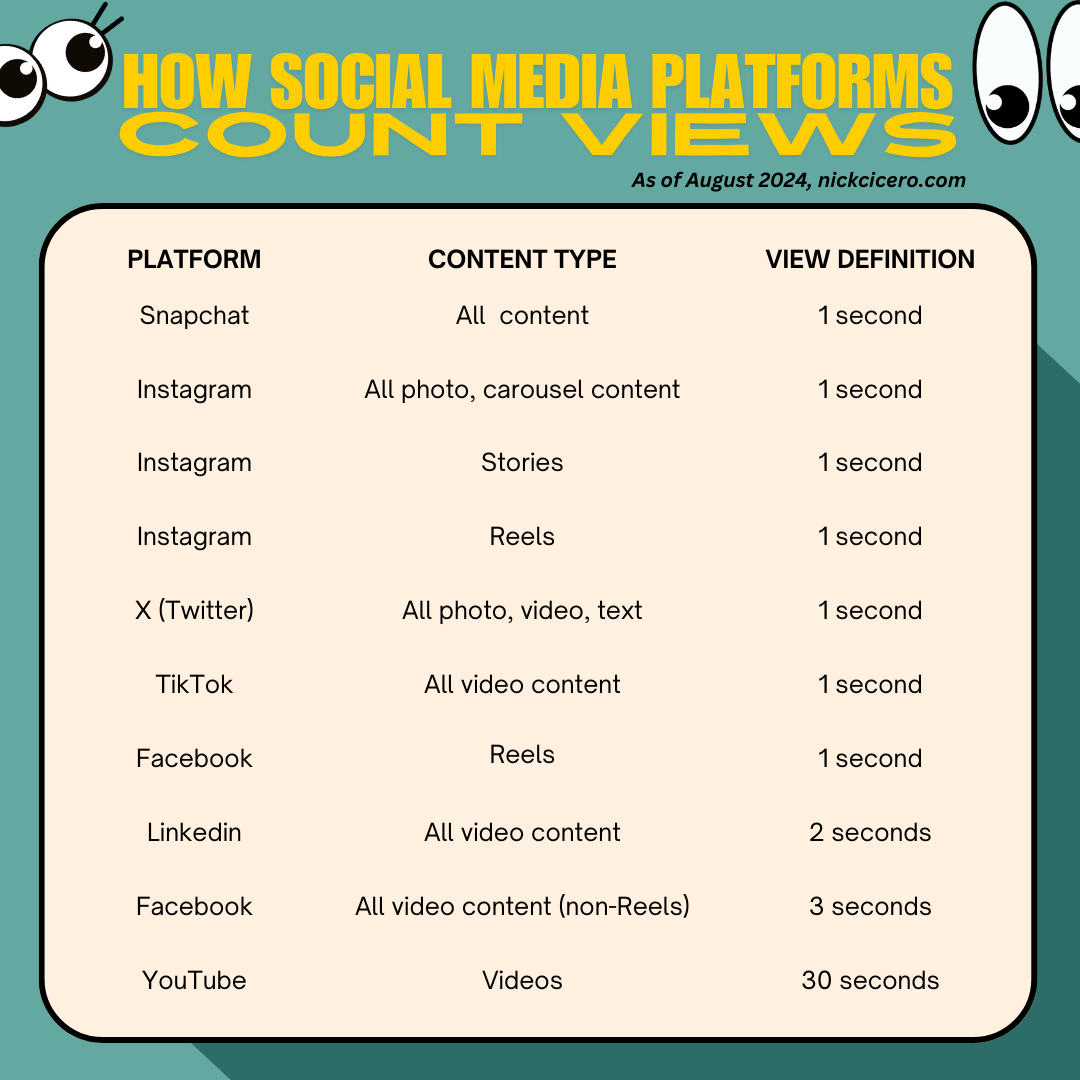
I’ve created a simple chart outlining what defines a view in 2024 but looking forward to hearing all the reactions from the industry to this change.

UPDATE:

Thanks to Casandra Lopez at Google for clarifying how a view is counted on YouTube Shorts:

For hashtag Shorts we have different scenarios; a view is counted when:

⚡ For videos less than 10 seconds: Viewers watch the full video or click on the call-to-action button.
⚡ For videos over 10 seconds: Viewers watch over 10 seconds or click on the call-to-action button.
⚡ A viewer clicks on the call-to-action button of a video ad.
The Death of Retention Editing?

You probably have never heard the term “retention editing” but you’ve definitely seen it. 📹 This social video editing approach, characterized by rapid cuts, flashy, interruptive graphics, arresting sound fx, high-energy transitions, and a relentless pace, aims to maximize viewer engagement and combat the ever-shortening attention spans.

The last 4 years on YouTube have been “The Retention Era” but that’s about to come to an end (sort of). Mr. Beast (Jimmy Donaldson) recently called for a slowdown in the rapid pace of video editing commonly seen on YouTube. He argues that the fast-paced editing style may not be sustainable or necessary for engaging viewers. Instead, he suggests that creators focus on storytelling and content quality to retain audience interest.

Just as art movements have risen and fallen in response to societal changes, technological advancements, and evolving aesthe

tic values, so too does the art of video production on platforms like YouTube.

Maybe we will look back and consider “retention editing” like the “impressionist period” for YouTube.

I loved my conversation with Taylor Lorenz for the The Washington Post – exploring the parallels between art movements and YouTube editing trends. This analogy extends beyond mere editing styles. It’s about understanding our work in the broader context of art history, recognizing that we’re part of a continuous flow of creative evolution.

It was also picked up by MIT Technology Review as their Quote of the Day.


Variety – Conviva Acquires Delmondo, a Social Video Analytics Startup

Conviva, which delivers real-time measurement of premium streaming video, is digging into the social scene with the acquisition of Delmondo.

Delmondo, founded in 2014, measures video consumption and engagement across Facebook, Instagram, YouTube, Twitter, Snapchat and Twitch. With the acquisition, Conviva will become the first company to offer a solution that brings together census-level streaming TV metrics with audience intelligence from social media platforms, according to CEO Bill Demas.

“Our customers will have a better sense of the consumer journey — and how to close the loop,” Demas said.

About a dozen Delmondo employees have joined Conviva, including founder and CEO Nick Cicero, who is now Conviva’s VP of social intelligence. The former Delmondo crew remains based in New York City.

Using Delmondo’s data, TV and video publishers can build content, advertising and promotional strategies using normalized consumption and audience intelligence from the largest social platforms, according to Conviva. For example, Delmondo’s analytics can help streaming providers track how video clips on social sites lead to consumers ultimately subscribing to their service.

Demas also noted that Delmondo is an official Facebook Media Solutions Partner, which gives it real-time intelligence for Facebook Watch, Facebook Live, Instagram and Instagram Stories.

Conviva and Delmondo have several mutual customers, including Turner, Viacom, WWE, and Fox Sports. “Our customers basically asked for this solution,” Demas said. “They said, ‘Let us better understand consumer intent.’”

Turner VP of emerging media Peter Scott, who has worked with both companies, gave a thumbs-up to the acquisition. “Conviva has been terrific in illuminating operational and audience insight heuristics to empower publishers,” he said in a statement. “Adding Delmondo will expand Conviva’s capabilities across social media giving us a complete fandom story.”

Delmondo’s investors included BRaVe Ventures, a strategic media consulting group co-founded by David Beck and Jesse Redniss. Turner acquired BRaVe Ventures in 2016.

Cicero, in a prepared statement, commented, “We’re excited to be merging with Conviva to build out the next-generation measurement and intelligence solution for streaming TV providers that includes premium audience content across social and OTT [over-the-top video services].”

With the acquisition, Delmondo’s analytics service has been rebranded as Conviva Social Insights, sold separately from the Conviva suite of performance-monitoring products. Next spring, Conviva will potentially integrate the Delmondo capabilities into another product, according to Demas.

Conviva bought Delmondo with a mix of cash and stock, according to Demas. He declined to disclose specific financial terms for the deal, which closed Nov. 13.

Foster City, Calif.-based Conviva has about 200 clients globally, including HBO, Hulu, Sky, Dish Network’s Sling TV and Turner. All told, the company monitors some 50 billion video streams per year across 3 billion apps and 200 million users, Conviva says.

Privately held Conviva has raised about $110 million to date from investors including AT&T’s WarnerMedia Investments (formerly Time Warner Investments), Future Fund, New Enterprise Associates, and Foundation Capital. The company has around 250 full-time employees.